Monday, September 28, 2009
Leaving The USA
Tuesday, September 15, 2009
Fort Ticonderoga and Crown Point
On the way south to Ticonderoga, we crossed lake champlain at crown point another important fort of the 1750s. The French built Fort St. Frederic on this site in the 1730s to control the lower reaches of Lake Champlain from the British and to overawe the native indians. This building included an immense stone tower more in keepiong with a medieval city than a frontier fort. As British aspirations on lake champlain increased the French realised the weakness of the fort to modern cannons and destroyed the fort at the approach of a British invasion force under Gen. Sir Jeffrey Amherst in 1759. The British immediately recognised the importance of this area for control of the lake and began construction of their own fort at Crown Point.
The fort was built in the typical Vauban style of the period with a central parade ground and mess buildings and a series of blockhouses and redoubts beyond the walls of the fort to protect the landward side. The fort was garrisoned weakly in the american war of indepence and was captured and used as a base for Gen. Benedict Arnolds campaign on the lake. With the loss of the American fleet at the battle of Valcour Island in 1776, the fort was abandoned. Despite a fire in 1773 destroying a large amount of the buildings inside the fort the walls and stone officers and soldiers quarters are still standing. A stroll around the walls is well worth the time. A small amount of remains from Fort St. Frederic can also be seen.
Travelling a few miles further south you come to Fort Ticonderoga. This impressively intact fort was begun by the French in 1755 and completed as Fort Carillon in 1758. The fort was attacked twice by the British in the Frecn Indian war. The first assault resulted in the catastrophic British defeat at the Battle of Carillon, 1758. Gen. James Abercrombie launched an unprepared assault against extensive abatis and field works placed by Gen. Montcalm some distance from the fort. The later siege resulted in the capture of the fort largely intact in 1759.
The fort and the overlooking hill of Mount Independence were captured by the British in 1777 as part of Gen. John Burgoynes Saratoga campaign. Following the defeat of the British at Bemis Heights both Ticonderoga and Crown point were abandoned.
Saturday, September 5, 2009
Washington DC
Amongst the landmarks are the Capitol building, seat of the US congress. Work began in 1795 leading to both wings being completed by the time of the war of 1812. In August 1814 British troops partially burnt the building. Further work resulted in the completion of the central rotunda in 1864 during the civil war.
The White house was begun in 1792 and has housed every US president since John Adams. It was completed in 1800 and like the capitol building partially burnt during the British occupation of Washington in 1814.
Ford's theatre (now a museum) has been
The Lincoln memorial stands at the end of west end of the national mall. It was originally commisioned in 1867 but work did not begin until 1914 and it was not completed until 1922. A Greek style front was based upon the Temple of Zeus. Inside sits a white marble depiction of Abraham Lincoln.
To either side of Lincoln are inscribed the key speeches of his presidency; the gettysburg address and the 2nd inauguration speech. Personally i found this monument one of the most moving in the whole of Washington, principally i think for the high moral ideals yet practical reasoning of Lincoln. Behind the monument is the bridge across the potomac to Arlington cemetery. Everything in this city is spread out so bring good walking shoes.
The cemetery was proposed by Quartermaster General Meigs in 1864 during the ACW. Meigs had recently lost his own son in the conflict and a national cemetery on the land of General Lee who had originally been offered command of the Northern forces was thought by many to be appropriate.
The cemetery has a wellcome centre which provides paper maps, which are generally useful listing some of the more famous incumbents, but actually finding their graves is a little more difficult. Key military incumbents include Maj Gen Phil Sheriden, Abner Doubleday not to mention numerous service personnel from the AWI onwards, including a separate section containing soldiers of the confederate states.
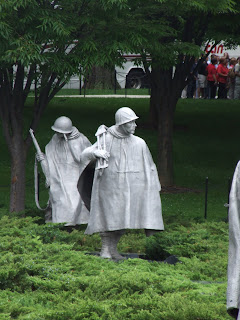
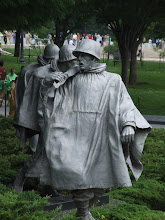
Other more recent conflicts are obviously represented by a significant array of monuments both in the cemetery and throughout Washington DC. Personally i found the most striking to be the US marine corps (Iwo Jima), for its sheer size and spectacle, and the Korean War monument for the gentle beauty of the simplistic yet moving platoon models.
Saturday, August 29, 2009
first post
i have a variety of interests but an overriding theme has been the franco-prussian war of 1870-71 which i have had a fascination with since seeing the figures of alan and michael Perry now produced by Foundry when i was about 12 years old. since then i have developed other waragming interests ranging from ancient rome to WW2 via the ECW, AWI, ACW etc. My wargaming introduction came, like a lot of people of my generation, from Games Workshop and Citadel Miniatures in the 1980s and whilst this may be sacriligous to many die hard historical gamers it certainly allowed me to develop an interest in miniature gaming that i certainly wouldnt have been able to get into otherwise. Nowadays i own virtually no fantasy figures having moved virtually completely to historical gaming, but i still hold an interest in the rich background of both GWs warhammer and 40k worlds.
i mainly game with 28mm miniatures but also have a fair collection of 15mm figures and have recently made a slight foray into 6mm napoleonics. mainly i prefer 28mm figures as i usually end up doing more painting than gaming and enjoy the visual character of 28mm figures particularly those produced by my favourite sculpters such as the Perry twins. Over time you will be able to see my work as it is produced, and please feel free to comment